Article

One of the questions we are asked most often is also one of the simplest:
What actually happens during a cheese workshop?
Some participants imagine a formal lecture. Others picture a silent tasting—or, at the opposite extreme, a casual aperitif with a few cheeses.
The reality is quite different.
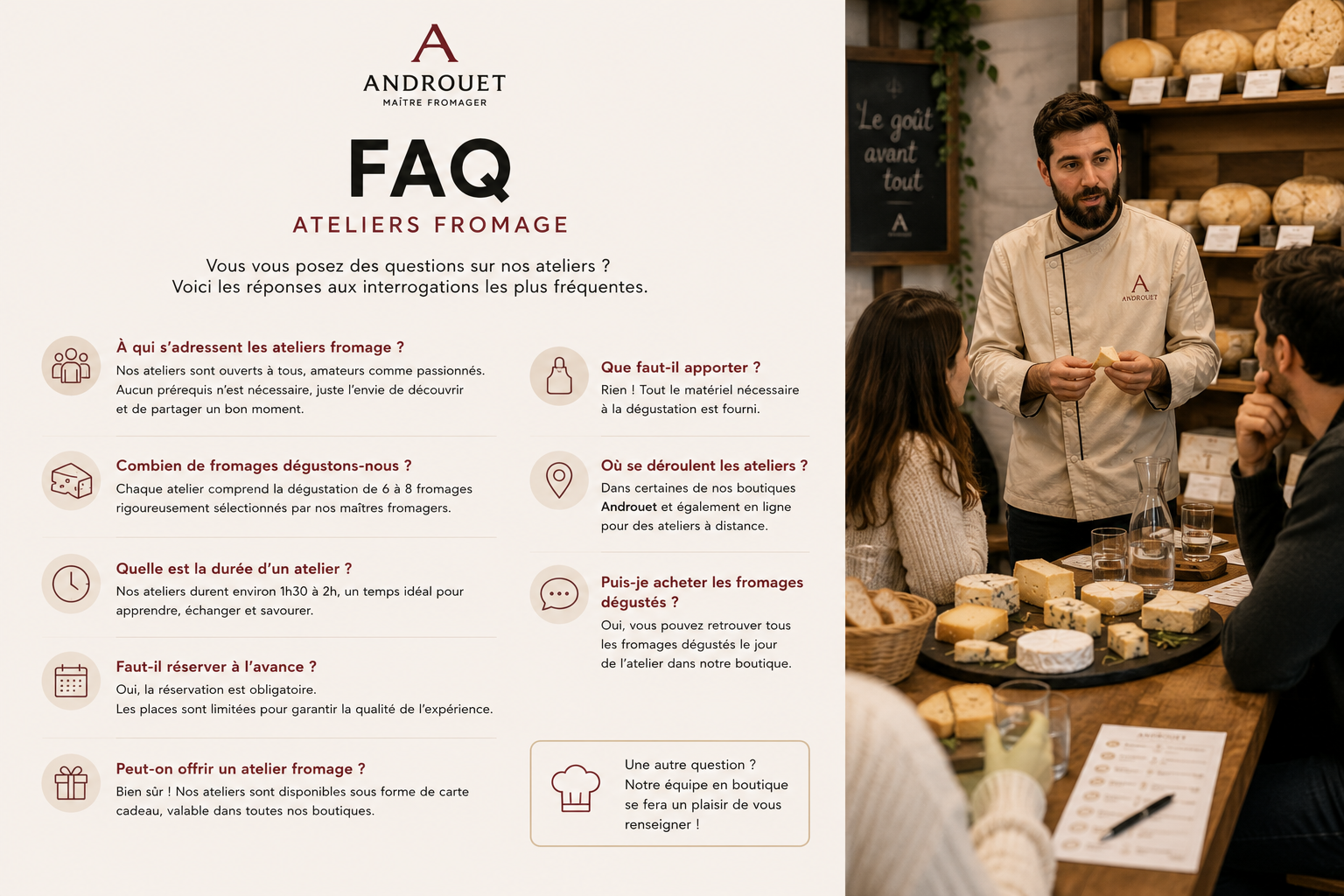
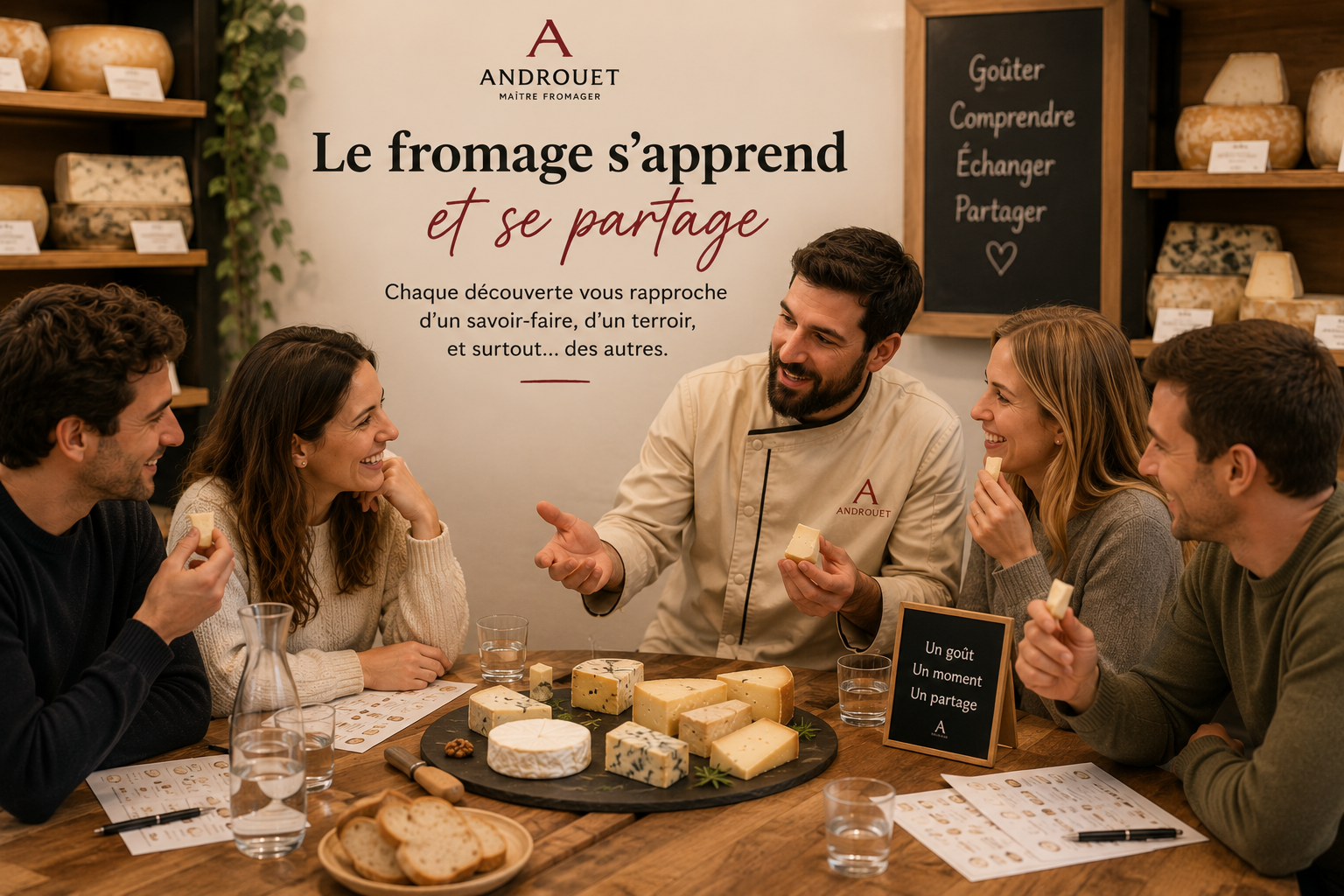
An Androuet workshop is a lively, interactive experience combining tasting, conversation, discovery, anecdotes, and practical advice. Over the course of nearly two hours, participants gradually learn how to observe cheese like a Master Cheesemonger, understand its story, and develop their palate.
No previous knowledge is required.
Curiosity is all that matters.
Every workshop begins with welcoming the participants.
Group sizes are deliberately limited to encourage conversation and make it easier for everyone to take part.
Introductions quickly create a friendly and relaxed atmosphere.
The people gathered around the table are often very different.
You may find:
This diversity is one of the great strengths of every workshop.
“In the same group, we might have a chef, a student, a retired guest, and someone who thinks they do not like cheese. By the end, everyone is talking as though they have known one another for years.”
— Guillaume, Androuet Master Cheesemonger
Every workshop has a clear theme.
Depending on the session, it may focus on:
The Master Cheesemonger introduces the objectives of the session so that everyone understands what they are about to discover.
The aim is never to learn everything in a single evening.
Each workshop is built around a carefully selected number of ideas, leaving enough time to observe, taste, discuss, and ask questions.
The first surprise comes quickly.
Contrary to what many people expect, tasting does not begin with the mouth.
It begins with the eyes.
The cheeses are introduced one by one.
The Master Cheesemonger draws attention to details such as:
Every detail reveals something.
A bloomy rind does not evolve in the same way as a washed rind.
A slightly glossy paste does not suggest the same level of maturity as a drier one.
Before taking the first bite, participants are already learning how to “read” a cheese.
Every cheese has an identity.
Before tasting it, the Master Cheesemonger will usually explain:
At Androuet, we like to remind participants that no cheese ever appears by chance.
It is always the result of a place, a climate, a herd, a producer’s expertise, and a period of affinage.
Understanding this story naturally prepares the palate for the tasting to come.
The next stage involves a closer examination of the cheese.
Participants learn how to recognize:
Touch also plays an important role.
The resistance of the cheese beneath a knife—or sometimes beneath the fingertips—can provide valuable clues about its maturity.
“A cheese speaks through its texture just as much as through its flavor.”
— Claire, Androuet Master Cheesemonger
Before tasting, everyone takes time to smell the cheese.
This is a step many people overlook at home.
Yet a large part of flavor is perceived through the sense of smell.
The Master Cheesemonger helps participants identify broad aromatic families such as:
There is never one “correct answer.”
Each participant gradually develops their own aromatic memory.
Only after all these stages does the cheese reach the palate.
It is tasted slowly.
Participants are invited to pay attention to:
They quickly discover that a cheese continues to evolve in the mouth for several seconds.
Some flavors appear immediately.
Others emerge much later.
This gradual development is one of the most fascinating aspects of cheese tasting.
Unlike a traditional class, a cheese workshop is an ongoing conversation.
Impressions are shared freely.
So are questions.
Why is this cheese creamier?
Why does that one have such an intense aroma?
Why can two Comtés of the same age taste so different?
The Master Cheesemonger responds using practical, everyday experience.
These conversations often lead to stories about producers, explanations about aging cellars, or useful advice for enjoying cheese at home.
This spontaneity is one of the reasons every workshop feels unique.
Depending on the workshop theme, the cheeses may be served with different drinks.
Wine pairings naturally play an important role.
But participants also discover that certain cheeses work beautifully with:
These pairings help explain how different aromas interact, complement, or contrast with one another.
Toward the end of the workshop, the focus turns to practical applications.
Participants learn:
These simple tips often completely transform the way guests serve and enjoy cheese at home.
It is quite common for a participant to announce at the beginning:
“I do not like goat’s cheese.”
The Master Cheesemonger never tries to persuade them otherwise.
Instead, they simply offer several styles to compare:
A fresh goat’s cheese, an ash-coated cheese, and a more mature, drier example.
Very often, that same participant leaves carrying a goat’s cheese.
Not because their taste has suddenly changed, but because they have discovered that there is no single type of goat’s cheese.
There are countless textures, levels of maturity, and aromatic profiles.
Reawakening that sense of curiosity is perhaps one of the greatest successes of a workshop.
By the end of the session, participants have done far more than taste several cheeses.
They have learned how to observe, understand, compare, and appreciate them with greater precision.
They leave with a new vocabulary, practical advice they can use immediately, and, above all, a different way of looking at a food they thought they already knew.
That is the purpose of an Androuet workshop:
Not simply to introduce exceptional cheeses, but also to reveal the women, men, terroirs, and gestures that bring them to life.
For more than 115 years, this tradition of sharing knowledge has stood at the heart of the House of Androuet.
It is what transforms a simple tasting into a genuine gastronomic experience.
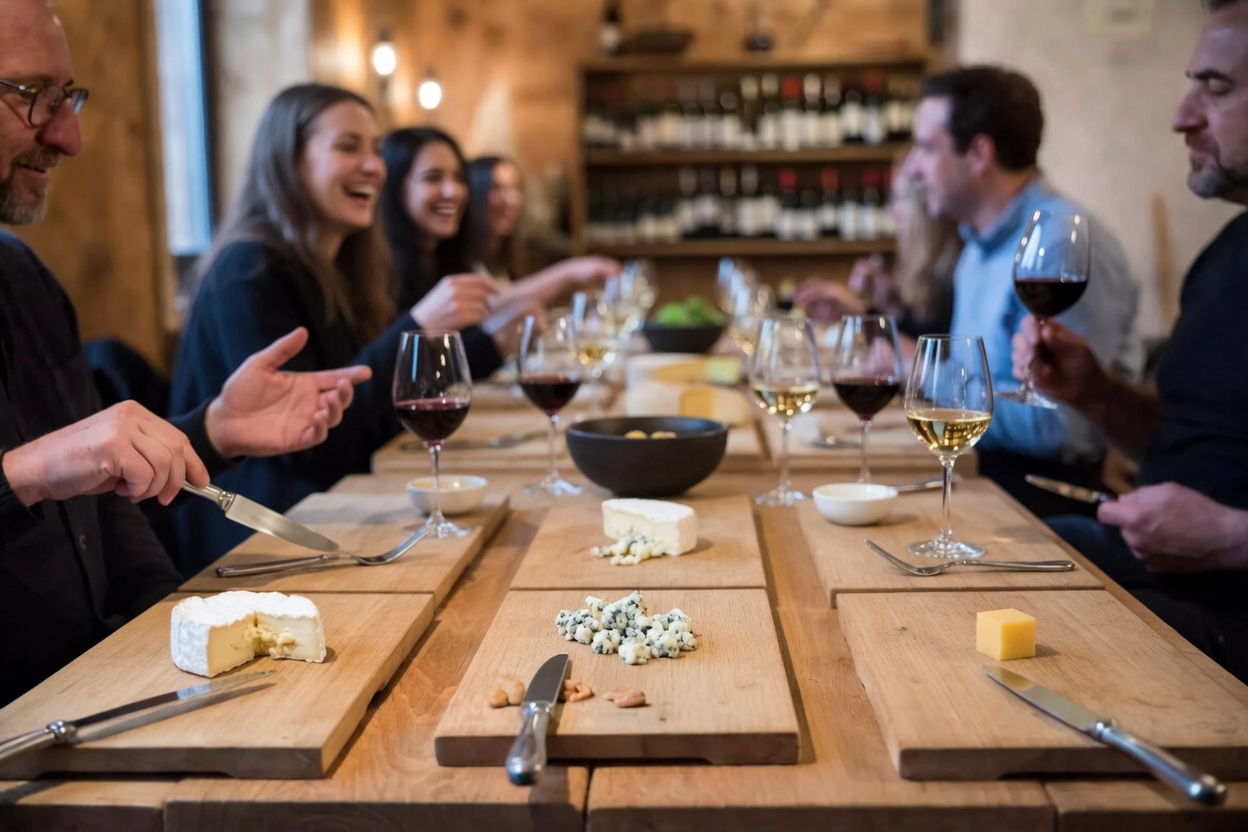
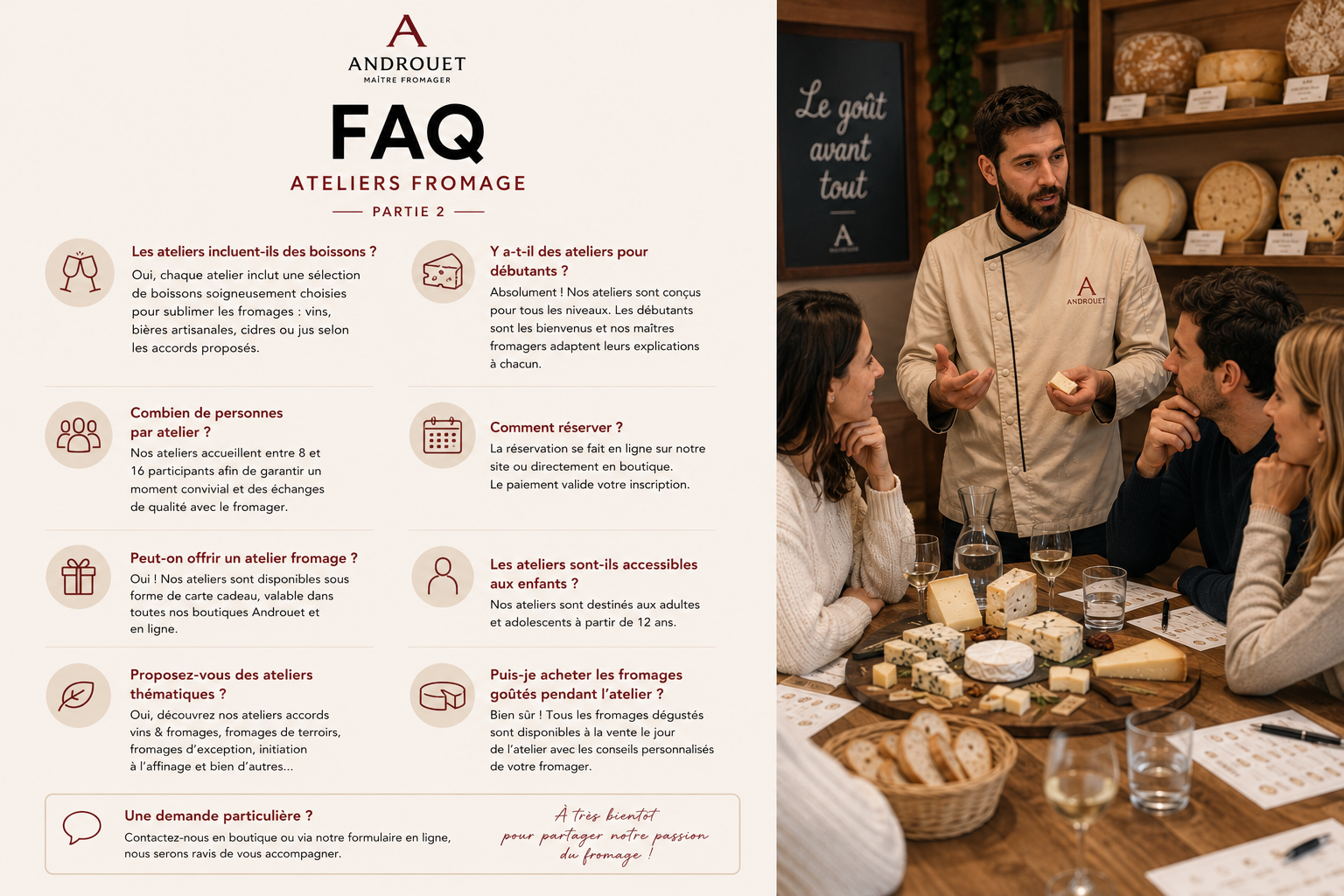
“Cheese discovery” workshop in Paris
Come and learn the subtle art of cheese and its pairings with our cheesemonger and affineur—an expert in the science of cheese.
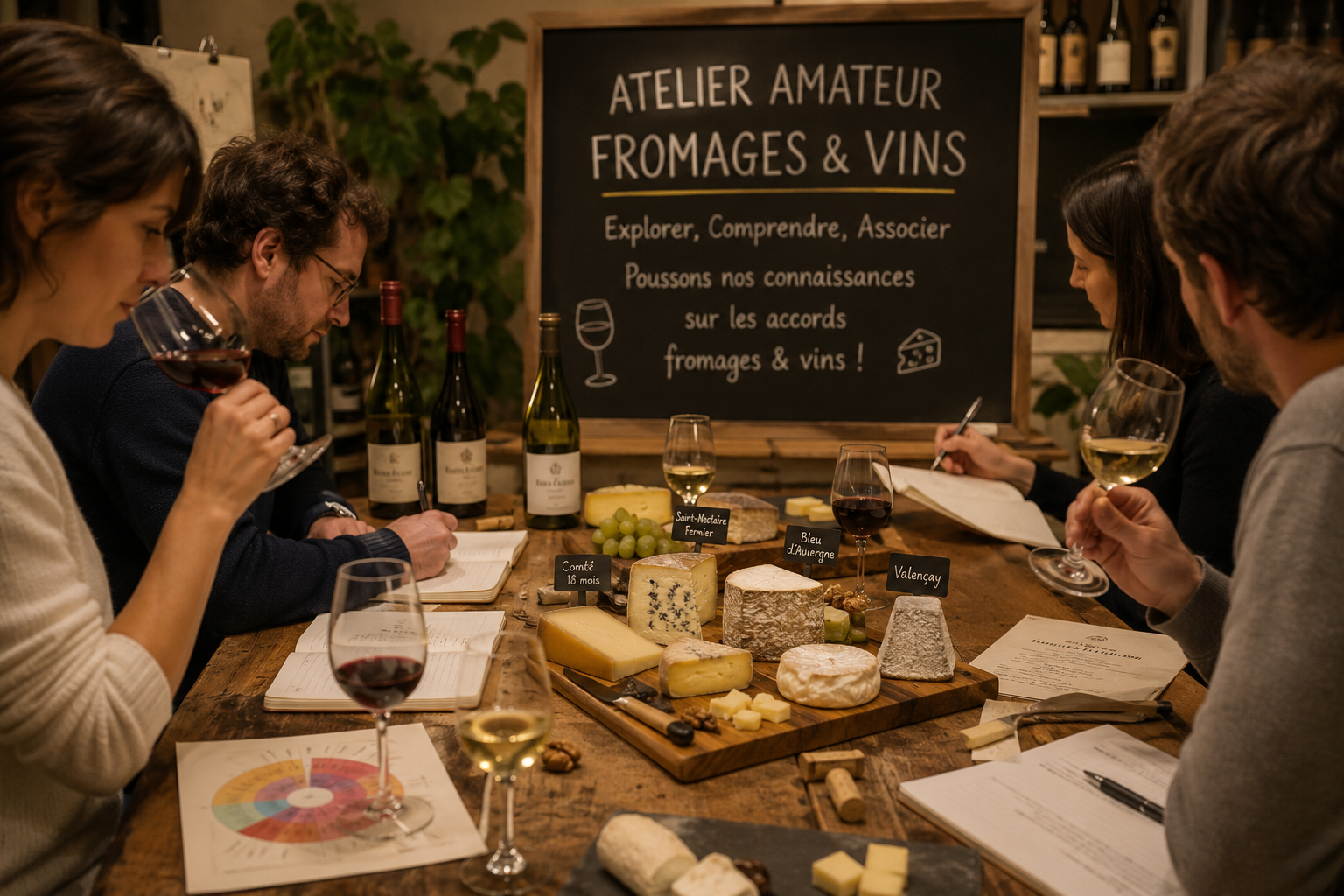
“Cheese enthusiast” workshop in Paris
Deepen your knowledge with this workshop on cheese and wine pairings.
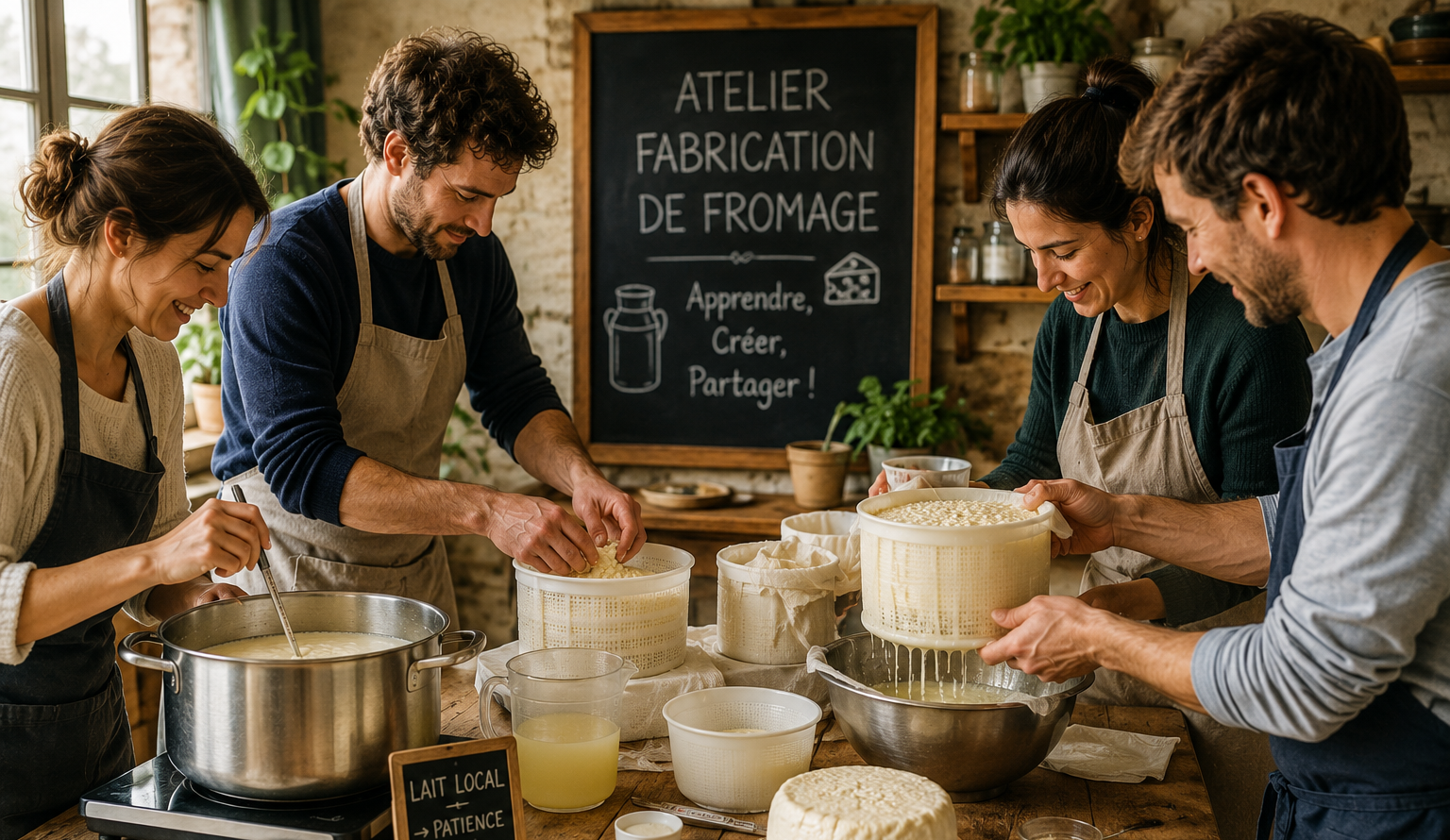
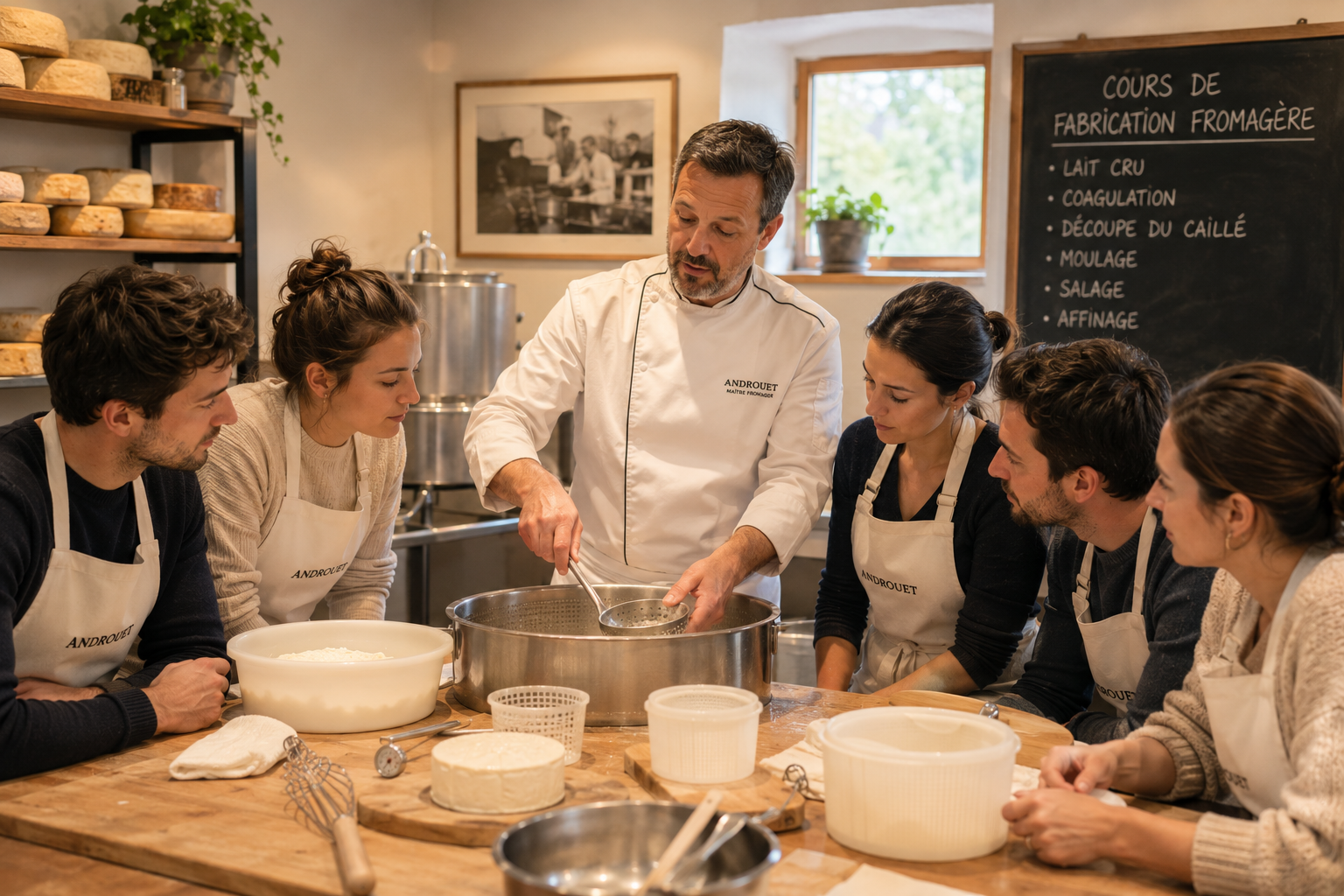
Cheese-making workshop in Paris
Learn how to make 3 cheeses.
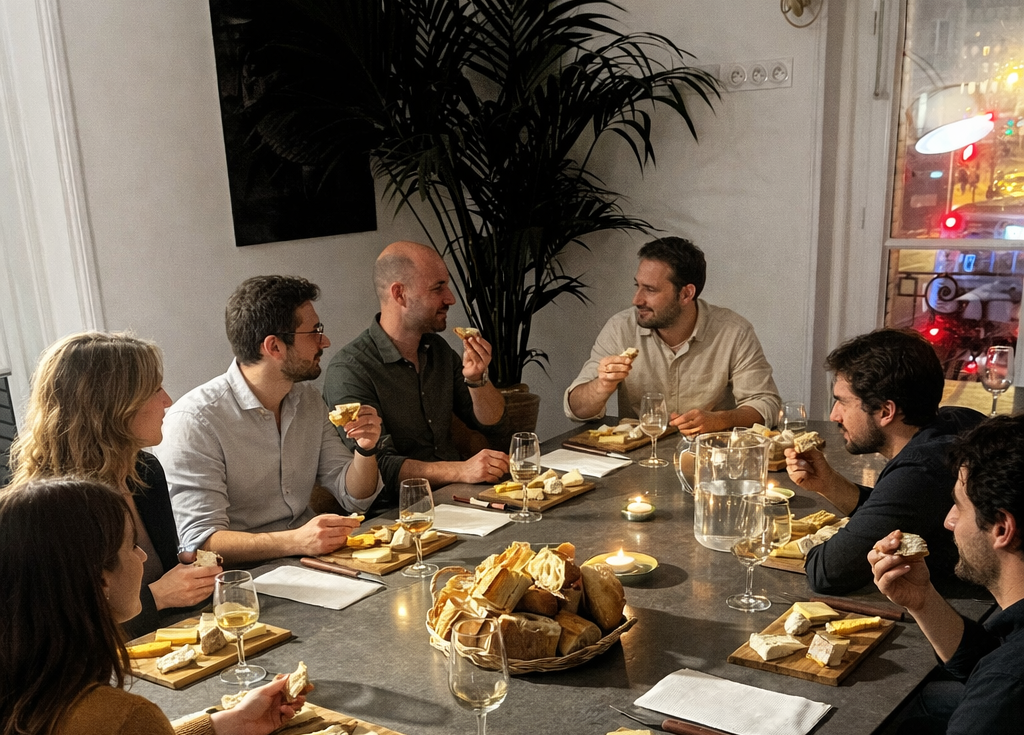
The “Secrets of Cheese” workshop in Paris
Learn, taste, and have fun. Come and discover this introduction to the art of cheese tasting. Learn to put your sensory impressions into words—all in a fun and cheerful atmosphere!
An Androuet exclusive.
Explore our guide to know everything about cheese from A to Z.