Article

Can you really learn to taste cheese like a professional?
The answer is yes.
Contrary to a common belief, Master Cheesemongers do not possess a mysterious natural gift. Their expertise is built above all on a method, refined through thousands of tastings.
They learn to observe, compare, remember, and analyze cheese with precision, while never losing sight of what matters most: pleasure.
At Androuet, this method has been passed down for more than 115 years. Each generation of Master Cheesemongers has enriched it by sharpening its eye, refining its vocabulary, and deepening its understanding of cheese.
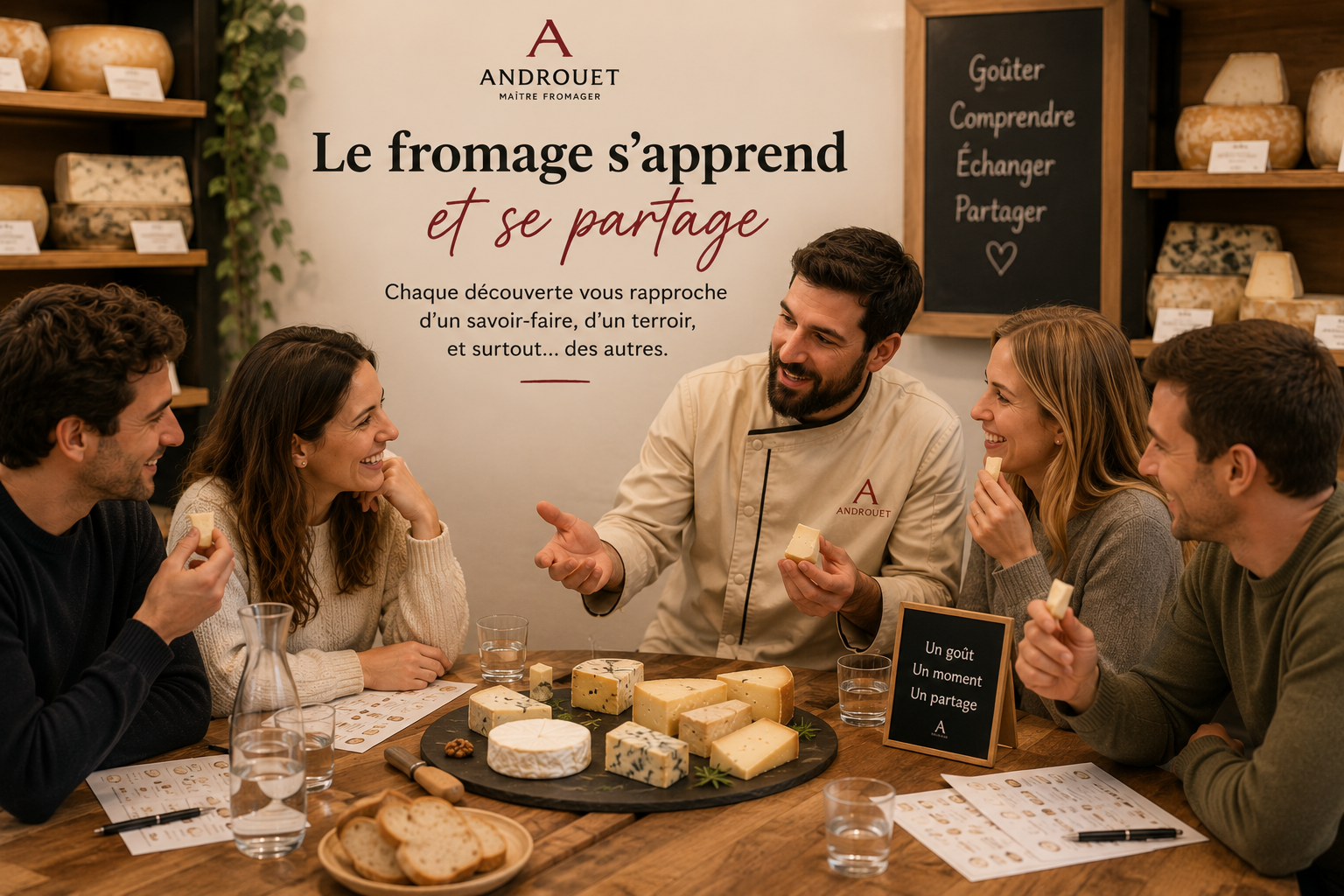
During our workshops, we adapt this professional approach so that anyone can use it easily at home.
The first instinct of most consumers is to cut a piece of cheese and eat it immediately.
A Master Cheesemonger does the exact opposite.
They slow down.
Before even thinking about tasting, they take a few seconds to observe the cheese as a whole.
Why?
Because a living cheese already reveals a great deal before the first bite.
“The greatest enemy of tasting is haste.”
— Jean, Androuet Master Cheesemonger
This first step may seem simple, but it can completely transform the quality of the tasting experience.
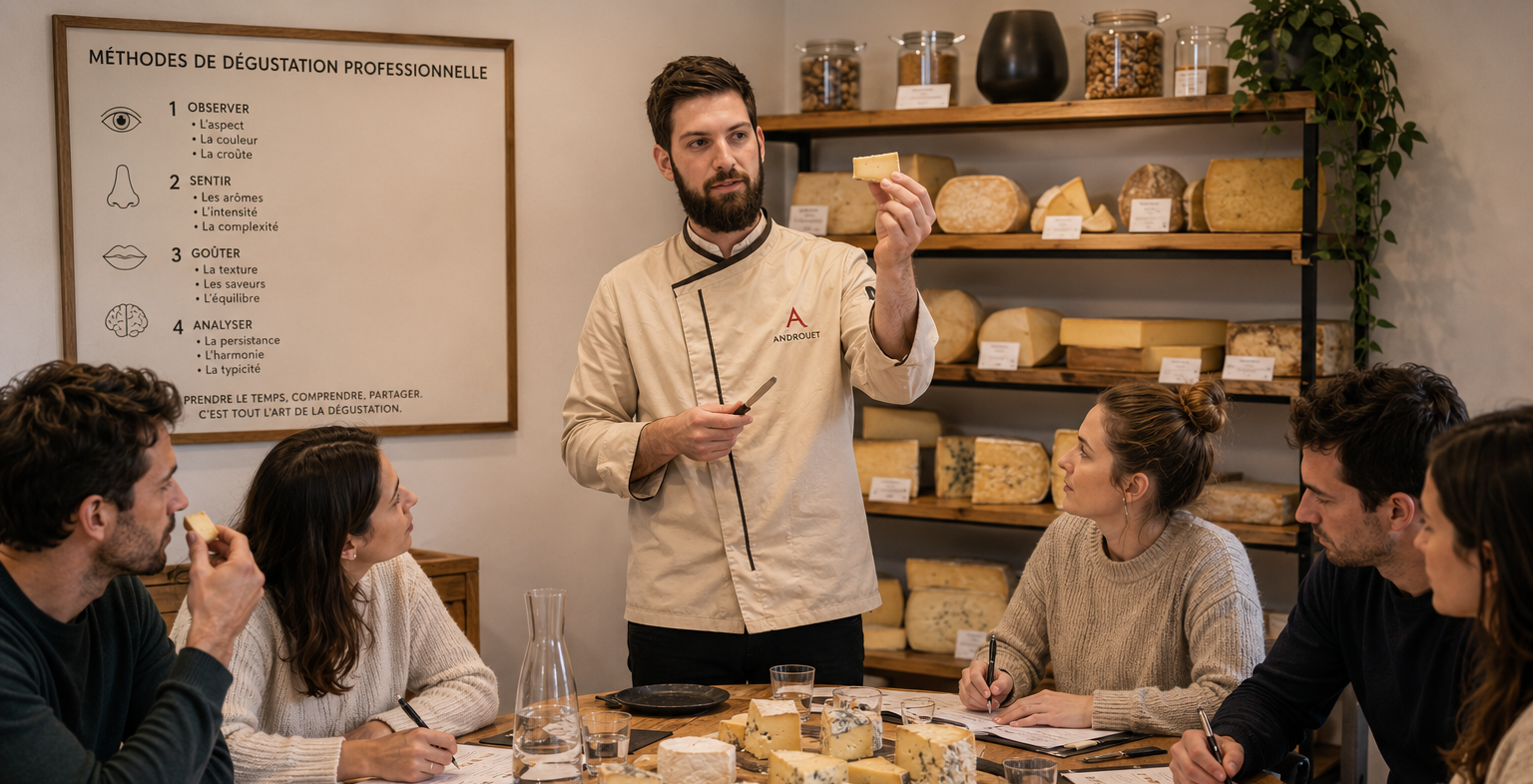
The eye is the taster’s first tool.
Before smelling or tasting, the Master Cheesemonger carefully examines several elements.
The rind is often the first source of information.
The cheesemonger looks at:
A rind reveals a great deal about how the cheese was made, how it has been matured, and where it is in its development.
The cut surface provides just as many clues.
A professional observes:
A perfectly even paste does not tell the same story as one with a more irregular structure.
The Master Cheesemonger also studies the way the cheese holds itself.
Does it sag slightly?
Does it remain perfectly firm?
Does it show a gentle swelling?
Every detail contributes to the overall assessment.
The sense of smell plays an essential role in tasting.
A cheese can contain dozens of aromatic compounds.
The Master Cheesemonger does not immediately try to identify every individual aroma.
Instead, they work by broad families.
For example:
This approach is far more effective than trying to identify one extremely precise scent from the beginning.
“Before learning to recognize roasted hazelnut, you first need to recognize the broader family of dried-fruit aromas.”
— Claire, Androuet Master Cheesemonger
Texture is often just as important as flavor.
It can reveal information about:
A professional analyzes:
Some cheeses appear very firm before becoming remarkably smooth and melting in the mouth.
Others are intentionally drier and more crumbly.
The tasting itself also follows a precise sequence.
The Master Cheesemonger looks for several distinct stages.
What are the first sensations?
Sweetness?
Acidity?
Saltiness?
Freshness?
A few seconds later, the cheese often begins to reveal its true personality.
The aromas develop.
The texture changes.
The flavors gain intensity.
This is often the stage at which the overall balance of the cheese becomes clear.
What remains after swallowing?
Some flavors disappear quickly.
Others linger for several seconds—or even much longer.
This persistence on the palate is often one of the defining qualities of a truly exceptional cheese.
A common mistake is to assign a score too quickly.
Professionals work differently.
They compare.
Is the cheese creamier than it was yesterday?
Softer than the previous one?
Less fruity?
More complex?
This constant process of comparison gradually creates a genuine tasting memory.
“We rarely taste a cheese in complete isolation. We are always comparing it with others. That is how the palate develops.”
— François, Androuet Master Cheesemonger
For a Master Cheesemonger, cheese is never static.
It changes.
Every day.
That is why tasting does not simply involve describing the cheese in front of you.
It also means imagining how it may evolve.
Will it become softer?
Will its aromas become more concentrated?
Will its texture become more fluid?
This ability to read a cheese dynamically is at the heart of the affineur’s profession.
Through repeated tasting, Master Cheesemongers develop an exceptionally precise memory.
They remember:
This memory allows them to recognize similarities and differences quickly.
The good news is that sensory memory develops gradually.
Every tasting enriches the next.
Saying that a cheese is “good” is not enough.
Professionals use more nuanced language.
They may describe:
During our workshops, this vocabulary is introduced gradually and without unnecessary jargon.
The aim is not to impress anyone.
It is simply to describe sensations more accurately.
Experience helps Master Cheesemongers develop a number of useful habits.
They avoid:
These simple principles significantly improve the quality of a tasting.
In the Androuet cellars, it is not unusual for the same cheese to be tasted on several consecutive days.
On the first day, it may still seem slightly closed.
Two days later, the paste may have become softer.
A week later, it may reach perfect balance.
Then, after a few more days, that harmony may begin to fade.
This daily evolution is exactly what our Master Cheesemongers monitor.
Their role is not simply to sell cheese.
It is to present each cheese at the precise moment when it offers the very best of itself.
You do not need twenty years of experience to apply this method.
By simply developing the habit of:
you will quickly begin to notice nuances that previously went unnoticed.
That is the purpose of Androuet workshops.
To share a professional method without ever forgetting that tasting should remain, above all, a moment of pleasure, discovery, and conviviality.
Because a great cheese does more than nourish.
It tells a story.
And learning how to taste it means learning how to listen.
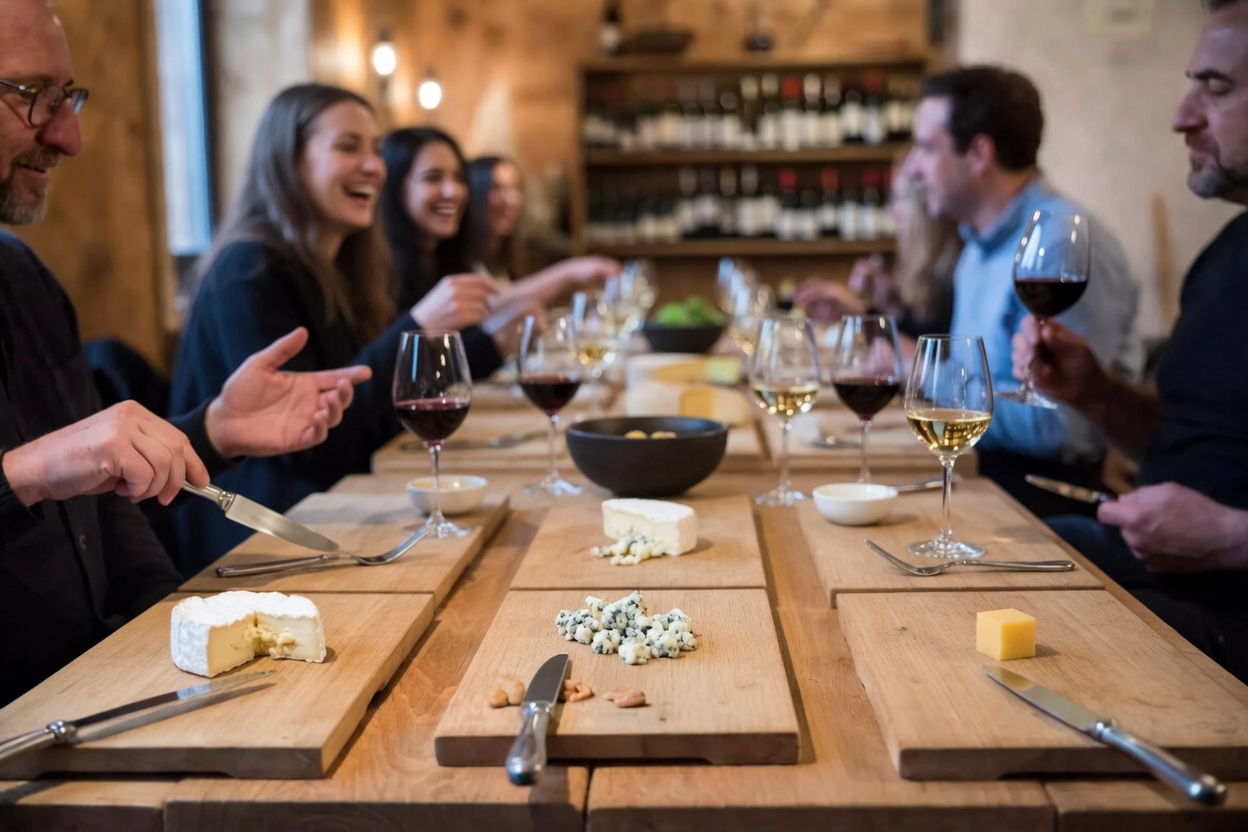
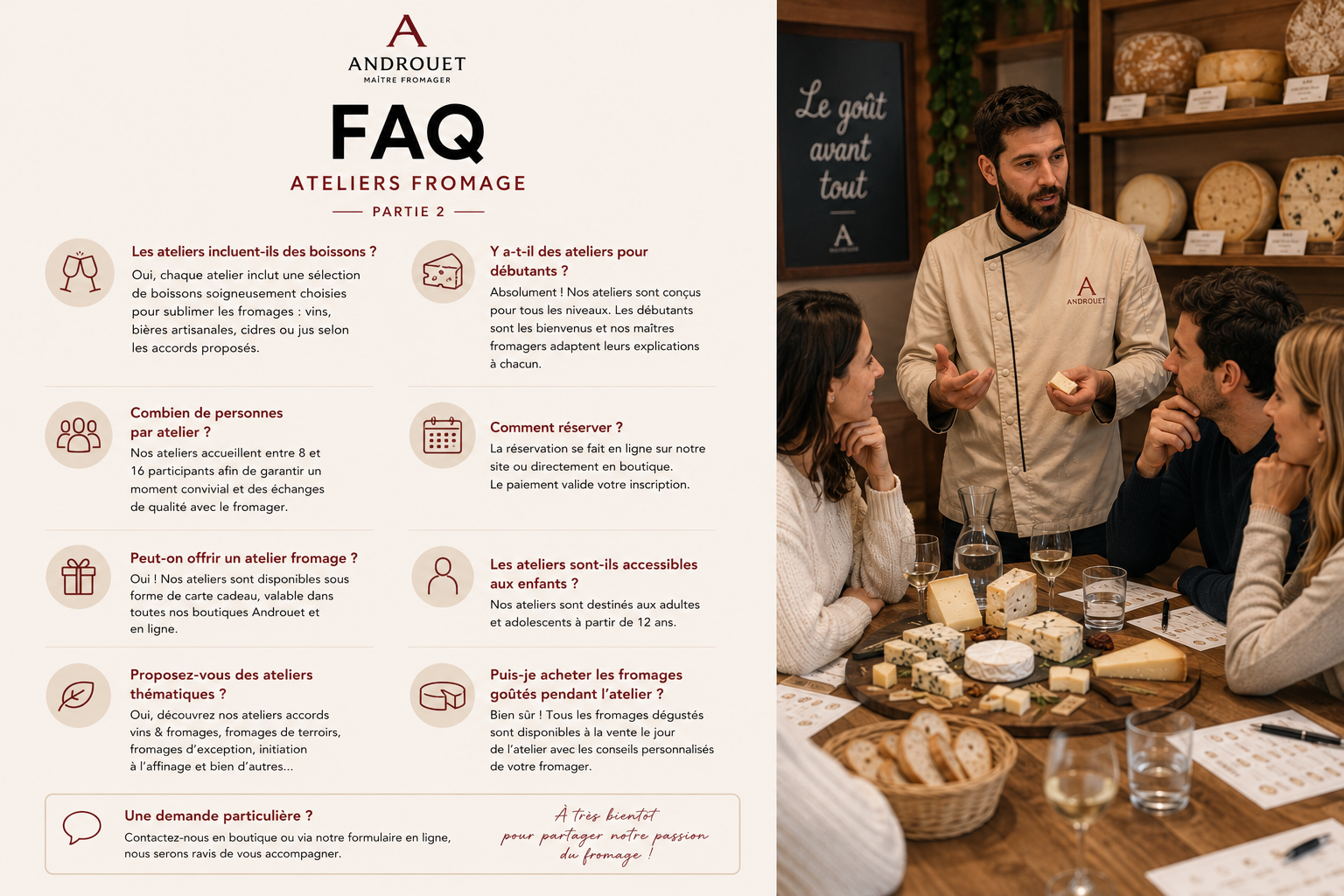
“Cheese discovery” workshop in Paris
Come and learn the subtle art of cheese and its pairings with our cheesemonger and affineur—an expert in the science of cheese.
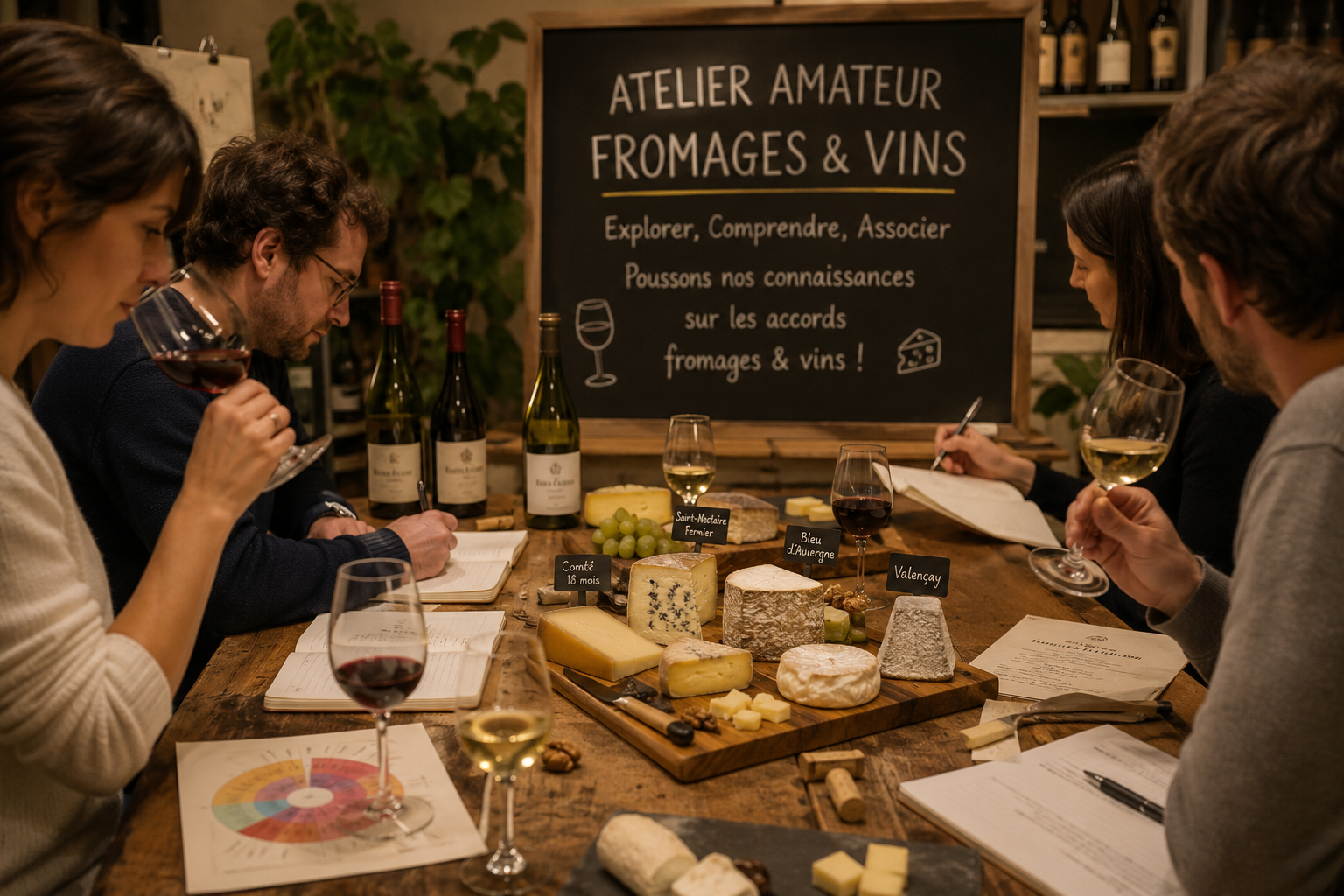
“Cheese enthusiast” workshop in Paris
Deepen your knowledge with this workshop on cheese and wine pairings.
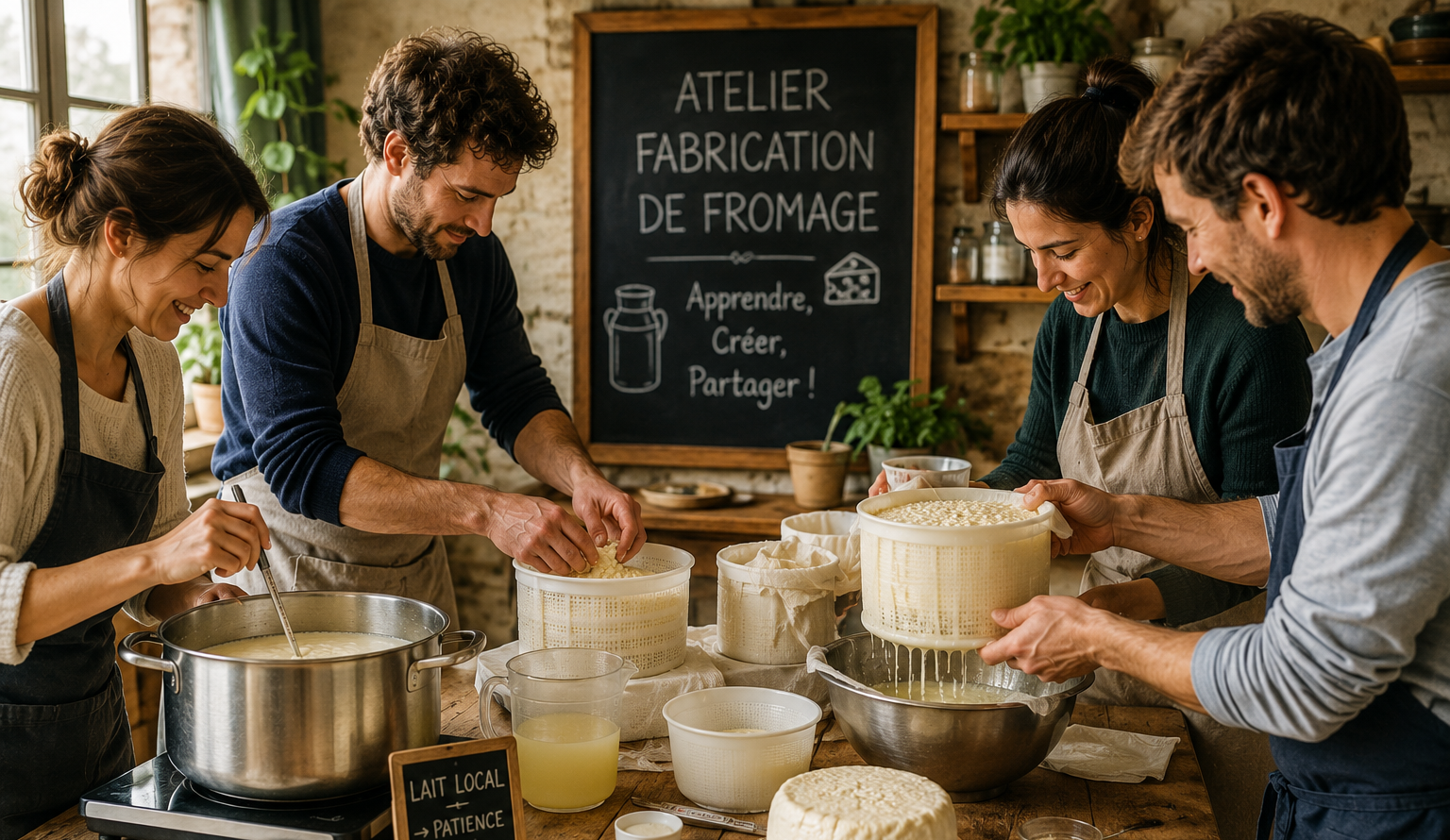
Cheese-making workshop in Paris
Learn how to make 3 cheeses.
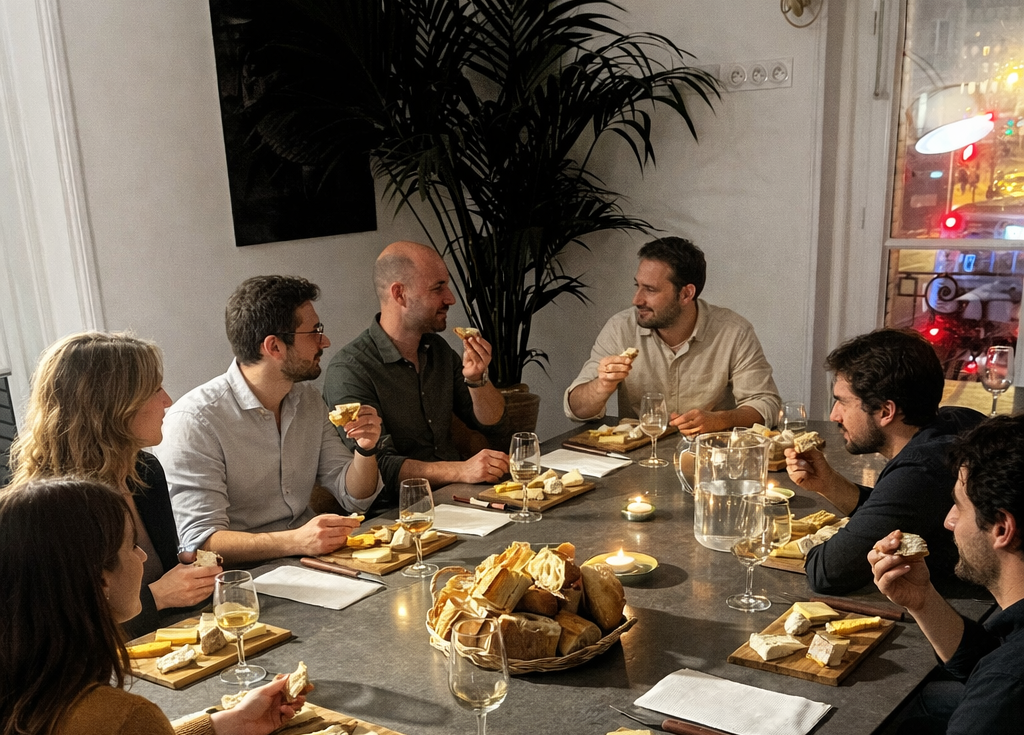
The “Secrets of Cheese” workshop in Paris
Learn, taste, and have fun. Come and discover this introduction to the art of cheese tasting. Learn to put your sensory impressions into words—all in a fun and cheerful atmosphere!
An Androuet exclusive.
Explore our guide to know everything about cheese from A to Z.